Cluely describes a meeting assistant that listens to a conversation and offers notes, answers and next steps. That combination makes sense when you need to remember a discussion and act on it afterward.
What should be left after the conversation?
Imagine a customer escalation discussed by a warehouse manager, an account lead and a delivery partner. For the next team meeting, a useful output is a record of the revised delivery date, the person responsible and the promise made to the customer. Cluely’s emphasis on meeting notes and next steps fits that job. Bring the same incident to a hiring panel and the useful output changes. The interviewer already knows the delivery slipped. What they want to understand is why you called the customer yourself and what you were prepared to promise.
Build the answer from three facts
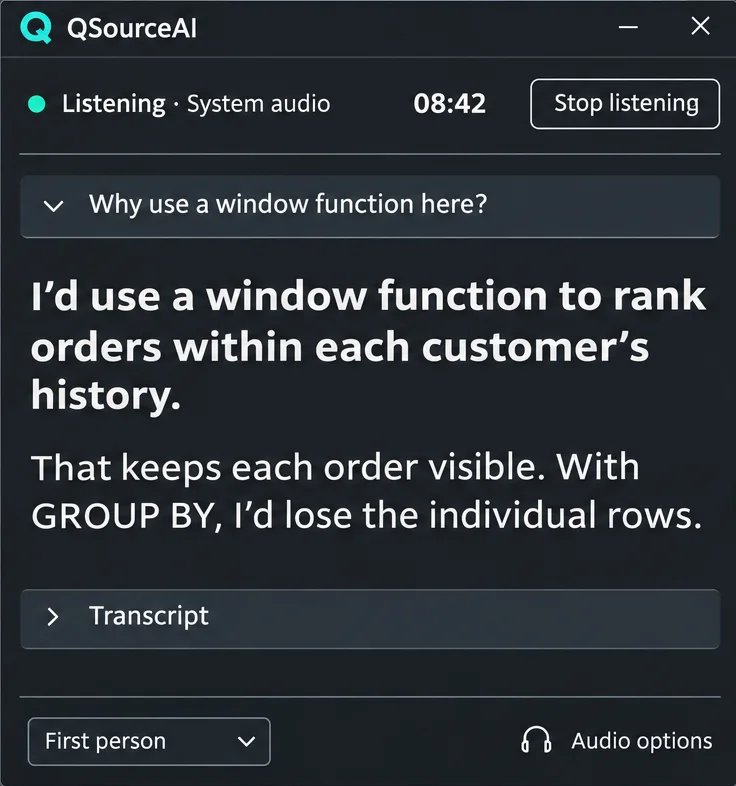
For a QSourceAI rehearsal, write three lines: “The delivery date slipped twice. I called the warehouse before contacting the customer. The customer agreed to a date the warehouse had confirmed.” Ask Main Chat for a short answer to “How did you rebuild trust?” Then inspect the verbs. “I confirmed,” “I called” and “I agreed” each tell the interviewer something about your contribution. “We delivered excellent service” takes up the same space without explaining a single decision.
Use the follow-up to test the distinction
Have a practice partner interrupt with “What if the warehouse had refused to commit?” That question asks for a hypothetical. A good response switches tense: “I would have agreed a time for my next update and explained what was still uncertain.” It should never rewrite your original story as though that refusal actually happened. In a permitted Pro session, use the reader for the first sentence, then look back to your partner. Notice whether you can finish the answer naturally once you have the opening.
Which workflow fits your week?
If your calendar is full of customer calls and you need a record other people can act on, start by evaluating Cluely’s meeting workflow. If the event you care about is a Windows interview where your own past decisions are the evidence, try the same story in QSourceAI. Judge a meeting tool by whether a colleague can pick up the next action. Judge an interview suggestion by whether you can defend every sentence when someone asks, “What did you do next?”
Product references
Cluely official product overview · QSourceAI interactive demo
A practical example
I called the customer after the missed delivery, agreed on a revised date with our warehouse, and stayed their point of contact until the order arrived.
Try this today
Write a handoff note and a 45-second interview answer about the same incident. Hand both to a colleague and ask which document they would use to brief the team, and which tells them how you make decisions.
Before you move on
- A named owner for the next step
- A first-person decision
- A clear distinction between fact and hypothetical
Real questions. Answers built around you.
Start with the 15-minute text trial on Windows. Pro adds live audio and screenshot analysis for US$85/month.